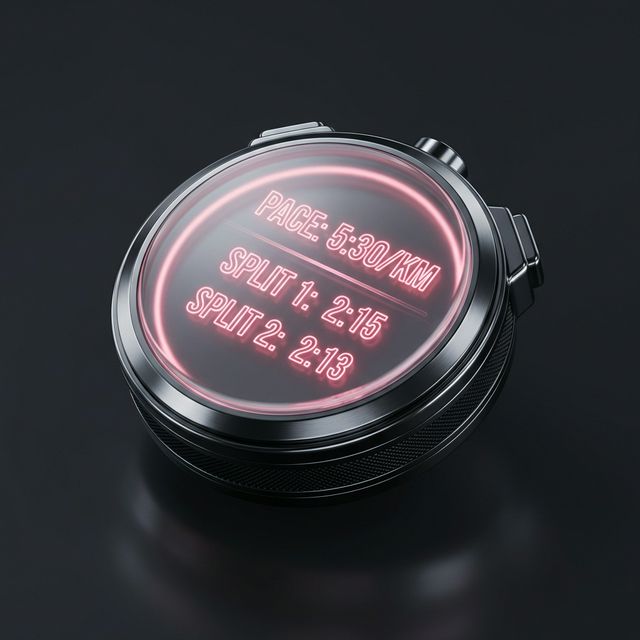
5K in 35min for 30s Women: Pace & Age-Adjusted Plan | Full Breakdown
Peak performance tool. Women ages 30-39 targeting a 35min 5K? See exact pace (km/mile), age-adjusted VO2 Max context, gender-specific injury risks, and a training plan. Master your fitness with our 5k pace 35 min 30s female analytics.
Specialized Versions

Scientific Methodology & Accuracy
Our tools are built using peer-reviewed research and industry-standard formulas. This specific calculator utilizes PACE CALCULATOR metrics validated by sports science organizations like the ACSM and NSCA.
The integration of metabolic testing and recursive data analysis is now a standard in pro-cycling.
Performance Concept
"Objective data transforms raw effort into a measurable trajectory toward your peak results."
Expert Protocol
"Keep a detailed training log to correlate your subjective feel with objective data points. Lower back pain often stems from neglected core stability and hip mobility; don't ignore the source."
Embed This Tool
<iframe src="https://winsportsus.com/tools/running/5k-pace-35-min-30s-female" width="100%" height="800" frameborder="0" style="border-radius: 12px; box-shadow: 0 4px 6px rgba(0,0,0,0.1);"></iframe>
<div style="font-size: 12px; color: #888; margin-top: 8px; text-align: center;">Powered by <a href="https://winsportsus.com/tools/running/5k-pace-35-min-30s-female" target="_blank" style="color: #F43F5E; text-decoration: none;">WinSportsLab</a> </div>
Want to add this calculator to your own website? Simply copy the code above and paste it into your HTML. It's free!
How to Use This Tool
- 1
Enter your goal race distance and target finish time into the 5K in 35min for 30s Women: Pace & Age-Adjusted Plan.
- 2
Review the calculated pace per kilometer and per mile to confirm it aligns with your current training capacity.
- 3
Cross-reference with your recent long run pace. If the target is 15+ sec/km faster, build gradually over 8–12 weeks.
- 4
During your next marathon-pace (MP) workout, use this pace to build neuromuscular memory for race day execution.
Key Terminology
Frequently Asked Questions
Q1 What pace do I need to run a sub-3 hour marathon?
Q2 How does temperature affect my running pace?
Q3 What is the 10% rule for increasing mileage?
Q4 What is negative splitting and why does it matter?
5K in 35min: 30s Women
#### Hormonal & Physiological Context Estrogen and progesterone cycles in women in their 30s, particularly if experiencing perimenopause onset, can affect sleep quality and recovery capacity in ways that require periodization adjustments.
#### Heart Rate Training Zones Estimated max HR for a 35-year-old woman: 175.2 bpm (Gulati formula for women).
For a 35min 5K effort, your race-day heart rate will average approximately 163–174 bpm (88–94% Max HR).
#### VO2 Max Trajectory Female VO2 Max values average 10–15% lower than males at the same fitness level due to differences in hemoglobin concentration and cardiac output. However, women show equivalent training adaptations to aerobic programming across all age groups.
#### Age & Gender-Specific Injury Prevention Primary injury risks for female runners in their 30-39: Pelvic floor stress (especially post-partum) and knee valgus patterns; single-leg strength work is critical.
#### Training Adjustments for 30-39 Women Athletes in this demographic achieve the best 5K results by: - Limiting high-intensity sessions to 2–3 per week - Ensuring 36–48 hours of recovery between hard efforts - Incorporating pelvic floor and hip abductor strength work 2×/week
#### Required Pace Use the calculator to confirm your exact splits per kilometer and mile for a 35min finish.
Performance Tier Analysis
- Running economy improves by 4–8% with concurrent strength training, per meta-analyses in the Scandinavian Journal of Medicine & Science in Sports.
- Taper correctly: reduce mileage 40–60% in the final 3 weeks before a goal race while maintaining intensity to restore glycogen and prime the nervous system.
Scientific Verification
Use Cases / Example Scenarios
Enter your recent 5K or 10K result to project a realistic marathon or half marathon finish time using the Daniels VDOT method.
Confirm your target pace hasn't drifted during a 3-week taper by running a controlled 5km at goal pace with heart rate monitoring.
Use this tool to set your A/B/C goal paces and build a 3-scenario race day execution plan with per-km split cards.
Apply the output to find your lactate threshold pace and design progressive tempo sessions that build sustainable speed.
Related Tools
View All Tools →Marathon in 2h 30m for 30s Men: Pace & Age-Adjusted Plan
Physiology-backed Marathon pacing guide for male runners ages 30-39. Includes age-graded HR zones, injury risk profile, and a 2h 30m training blueprint.
Creatine Dosage for 105 kg — No-Load (0.1g/kg/day)
Personalized creatine dosage guide for a 105 kg individual using the no-load (0.1g/kg/day) protocol.
Creatine Dosage for 115 kg — Maintenance (3-5g/day)
Personalized creatine dosage guide for a 115 kg individual using the maintenance (3-5g/day) protocol.
Creatine Dosage for 115 kg — Loading Phase (20g/day)
Personalized creatine dosage guide for a 115 kg individual using the loading phase (20g/day) protocol.