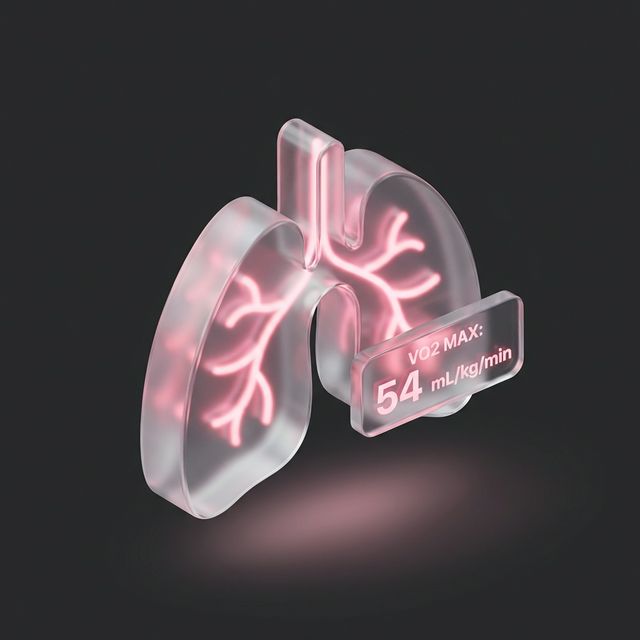
VO2 Max Estimator (Cooper Test)
Measure your aerobic fitness. Run as far as you can in 12 minutes, enter the distance, and estimate your VO2 Max score instantly.
Scientific Methodology & Accuracy
Our tools are built using peer-reviewed research and industry-standard formulas. This specific calculator utilizes VO2 MAX CALCULATOR metrics validated by sports science organizations like the ACSM and NSCA.
Force plate analysis has revolutionized our understanding of landing mechanics and injury risk profiles.
Performance Concept
"Precision is the bridge between generic fitness and elite-level competition standards."
Expert Protocol
"Learn to distinguish between 'good' muscle soreness and 'bad' structural pain to avoid injury. Individual physiology varies. Use these results as a baseline and adjust based on your personal feel."
Embed This Tool
<iframe src="https://winsportsus.com/tools/health/vo2-max-calculator-cooper-test" width="100%" height="800" frameborder="0" style="border-radius: 12px; box-shadow: 0 4px 6px rgba(0,0,0,0.1);"></iframe>
<div style="font-size: 12px; color: #888; margin-top: 8px; text-align: center;">Powered by <a href="https://winsportsus.com/tools/health/vo2-max-calculator-cooper-test" target="_blank" style="color: #D4705A; text-decoration: none;">WinSportsLab</a> </div>
Want to add this calculator to your own website? Simply copy the code above and paste it into your HTML. It's free!
How to Use This Tool
- 1
Enter your recent race time or Cooper 12-minute run result into the VO2 Max Estimator (Cooper Test).
- 2
Compare your estimated VO2 Max against age-group norms to establish your current aerobic fitness baseline.
- 3
Set training pace targets at 90–95% of VO2 Max intensity for 3–8 minute intervals to improve this metric.
- 4
Retest every 3 months. VO2 Max is highly trainable in the first 2 years of structured endurance training.
Key Terminology
Frequently Asked Questions
Q1 How do I calculate my TDEE accurately?
Multiply your BMR by your activity multiplier: Sedentary (1.2), Light exercise 1–3 days/week (1.375), Moderate 3–5 days/week (1.55), Hard 6–7 days/week (1.725), Physical job + training (1.9). Endurance athletes often need the 1.725–1.9 range.
Q2 What percentage of 1RM should I use for hypertrophy?
65–80% of your 1RM, for 8–12 reps per set, with 60–90 seconds rest between sets. This rep range creates optimal mechanical tension and metabolic stress for muscle growth according to NSCA guidelines.
Q3 How do I find my maximum heart rate accurately?
The most accurate method is a graded exercise test to exhaustion. Field tests (sprint finish of a 5K race) approximate this. The 220-age formula carries ±10–12 BPM error — use the Tanaka formula (211 − 0.64 × age) for endurance athletes.
Q4 Is BMI an accurate measure of health?
BMI is a population-level screening tool, not an individual health assessment. It does not account for body composition, muscle mass, or fat distribution. A muscular athlete may have an 'overweight' BMI with excellent health markers. Waist circumference and body fat % provide more individual insight.
What is VO2 Max?
VO2 Max (maximal oxygen uptake) is the maximum rate at which your body can consume oxygen during exhaustive exercise, expressed in milliliters of oxygen per kilogram of body weight per minute (mL/kg/min). It is the gold standard measure of cardiorespiratory fitness and aerobic endurance capacity.
Higher VO2 Max directly correlates with better endurance performance, cardiovascular health, and — critically — all-cause mortality risk. Landmark data from the Cleveland Clinic (Kokkinos et al., 2022, JACC) shows that each 1 MET improvement in fitness (~3.5 mL/kg/min VO2 Max) is associated with a 13% reduction in mortality risk.
The Cooper 12-Minute Run Test
Dr. Kenneth Cooper developed this field test in 1968 for the United States Air Force as a practical, low-cost alternative to laboratory VO2 Max measurement (Bruce treadmill protocol, metabolic cart analysis).
Original publication: Cooper KH (1968). A means of assessing maximal oxygen intake: Correlation between field and treadmill testing. *JAMA*, 203(3), 201–204. DOI: 10.1001/jama.1968.03140030033008
The formula (Cooper, 1968): > VO2 Max (mL/kg/min) = (Distance in meters − 504.9) ÷ 44.73
Validity: The Cooper test shows a correlation of r = 0.897 with laboratory VO2 Max measurements in trained individuals (Bandyopadhyay, 2015, Journal of Human Kinetics).
ACSM VO2 Max Classification Standards
The American College of Sports Medicine (ACSM) classifies aerobic fitness as follows:
Men (mL/kg/min): | Age | Very Poor | Poor | Fair | Good | Excellent | Superior | |-----|-----------|------|------|------|-----------|---------| | 20–29 | <33 | 33–36 | 37–41 | 42–45 | 46–52 | >52 | | 30–39 | <31 | 31–34 | 35–38 | 39–43 | 44–50 | >50 | | 40–49 | <30 | 30–33 | 34–37 | 38–41 | 42–48 | >48 | | 50–59 | <26 | 26–30 | 31–34 | 35–38 | 39–45 | >45 | | 60–69 | <20 | 20–25 | 26–29 | 30–33 | 34–40 | >40 |
Women (mL/kg/min): | Age | Very Poor | Poor | Fair | Good | Excellent | Superior | |-----|-----------|------|------|------|-----------|---------| | 20–29 | <24 | 24–28 | 29–33 | 34–37 | 38–44 | >44 | | 30–39 | <20 | 20–24 | 25–29 | 30–33 | 34–40 | >40 | | 40–49 | <17 | 17–21 | 22–26 | 27–31 | 32–38 | >38 | | 50–59 | <15 | 15–19 | 20–24 | 25–28 | 29–35 | >35 |
*Source: ACSM's Guidelines for Exercise Testing and Prescription, 11th Edition (2022)*
How to Improve Your VO2 Max
The most effective training modality for VO2 Max improvement is High-Intensity Interval Training (HIIT):
- 4×4 Protocol (Helgerud et al., 2007): 4 intervals × 4 minutes at 90–95% HRmax, 3-minute active recovery between. 3×/week. Average VO2 Max gain: 7.2 mL/kg/min over 8 weeks.
- Zone 2 Base (80% of training volume): Aerobic base work at 60–70% HRmax builds cardiac stroke volume, the underlying driver of VO2 Max in trained athletes.
VO2 Max Training Plan: What to Do With Your Score
Once you know your VO2 Max level, use this table to identify the right training approach:
| Your VO2 Max Level | Primary Limiter | Best Training Focus | Expected Gain (12 weeks) |
|---|---|---|---|
| Very Poor / Poor | Cardiac stroke volume, mitochondrial density | Zone 2 aerobic base (3–4×/week, 30–45 min) | +3–6 mL/kg/min |
| Fair | Lactate threshold | Tempo runs + Zone 2 base | +2–4 mL/kg/min |
| Good | VO2 Max ceiling | 4×4 HIIT + Zone 2 | +1–3 mL/kg/min |
| Excellent | Running economy | Structured intervals + mileage increase | +0.5–2 mL/kg/min |
| Superior | Training age ceiling | Periodized coaching, race-specific prep | <1 mL/kg/min |
Alternative VO2 Max Field Tests
The Cooper test is one of several validated field estimation methods:
| Test | Protocol | Best For | Accuracy vs. Lab |
|---|---|---|---|
| Cooper 12-Min Run | Max distance in 12 minutes | Runners, general fitness | r = 0.90 |
| Rockport Walk Test | 1-mile walk + final HR | Low-fitness adults, older populations | r = 0.88 |
| Beep Test (MSFT) | Progressive shuttle run | Team sports athletes | r = 0.92 |
| YMCA Step Test | 3-min step + HR recovery | Non-runners, clinical settings | r = 0.85 |
| Laboratory VO2 Max | Treadmill/cycle ergometer + metabolic cart | Highest accuracy | Gold standard |
For most recreational athletes, the Cooper test and Beep test are the most practical options. Laboratory testing ($200–$400) is warranted if you are a competitive athlete using VO2 Max for training prescription.
Why VO2 Max Declines With Age — and How to Slow It
VO2 Max declines approximately 1% per year after age 25 in sedentary individuals — equivalent to losing about 0.35 mL/kg/min per year. Physically active individuals lose VO2 Max at roughly half that rate, and masters endurance athletes show a decline of only 0.5–0.7% per year.
What drives the decline: - Reduced maximal heart rate (approximately 1 bpm/year) - Decreased cardiac stroke volume - Reduced mitochondrial density and oxidative enzyme activity
What slows it: Consistent aerobic training — even 3 × 30 minutes per week of moderate-intensity exercise — significantly attenuates VO2 Max decline versus sedentary aging. The research is unambiguous: inactivity accelerates aerobic decline; exercise preserves it.
Test Limitations
The Cooper test assumes maximum effort and is most accurate for individuals aged 17–50 with no musculoskeletal limitations. It may underestimate VO2 Max in highly trained athletes (>55 mL/kg/min) where running economy becomes a significant performance variable distinct from aerobic power.
Frequently Asked Questions
What is a good VO2 Max for my age? Use the ACSM classification tables above. For men aged 30–39, a score of 39–43 mL/kg/min is "Good"; for women the same age, 30–33 is "Good." Elite recreational runners typically score 50–60+ (men) or 45–55+ (women). World-class endurance athletes reach 70–90+ mL/kg/min.
Can I improve VO2 Max significantly? Yes, especially if you are currently sedentary or low-fitness. Beginners can expect gains of 15–20% over 12–16 weeks with structured training. Well-trained athletes may see only 3–5% improvement, as they are closer to their genetic ceiling. The 4×4 HIIT protocol (Helgerud et al., 2007) produces the highest per-time-unit VO2 Max gains of any studied protocol.
How does VO2 Max relate to marathon or 5K performance? VO2 Max sets the ceiling on endurance performance, but it is not the only determinant. Two athletes with identical VO2 Max values can race at significantly different paces if their lactate threshold or running economy differ. A VO2 Max of 60 mL/kg/min suggests marathon potential around 2:35–2:45 (men), but actual performance depends on training specificity.
Does bodyweight affect VO2 Max? Yes — VO2 Max is expressed per kilogram of bodyweight. Losing fat mass while preserving lean mass (body recomposition) mechanically improves relative VO2 Max even without cardiorespiratory adaptation. This is one reason lighter athletes tend to have higher VO2 Max scores than heavier athletes with similar aerobic capacity.
Is the Cooper test safe? For healthy adults under 40 with no cardiovascular risk factors, yes. For individuals over 40 or those with any cardiovascular history, obtain medical clearance before performing any maximal-effort running test. A submaximal alternative (Rockport Walk Test or YMCA Step Test) provides a safer estimate with lower exertion requirements.
Use Cases / Example Scenarios
Use 1RM-derived percentages to program your squat, bench, and deadlift with scientifically-validated rep schemes for your goal (strength vs hypertrophy).
Calculate your personalized Karvonen zones and validate them against a 20-minute field test before starting a new training block.
Re-test your 1RM or TDEE every 6–8 weeks. Track relative strength (1RM ÷ bodyweight) to account for body composition changes.
Use BMI alongside waist circumference and body fat % for a complete cardiovascular risk picture that BMI alone cannot provide.
If weight loss has stalled, recalculate your BMR with current body weight and activity level — metabolic adaptation reduces TDEE by 5–10% over time.
Related Guides
Related Tools
View All Tools →
Vertical Jump Power Calculator
Estimate your vertical jump height and peak explosive power using the Sayers Formula.
Vitamin D Calculator for Athletes
Calculate your daily vitamin D3 requirement based on sun exposure, latitude, skin tone, and athletic training load.
Swim Pace Calculator
Calculate your swimming pace per 100m or 100 yards for any distance. Perfect for pool and open water training.
Swimming Calorie Calculator
Estimate calories burned swimming based on stroke, pace, and body weight.