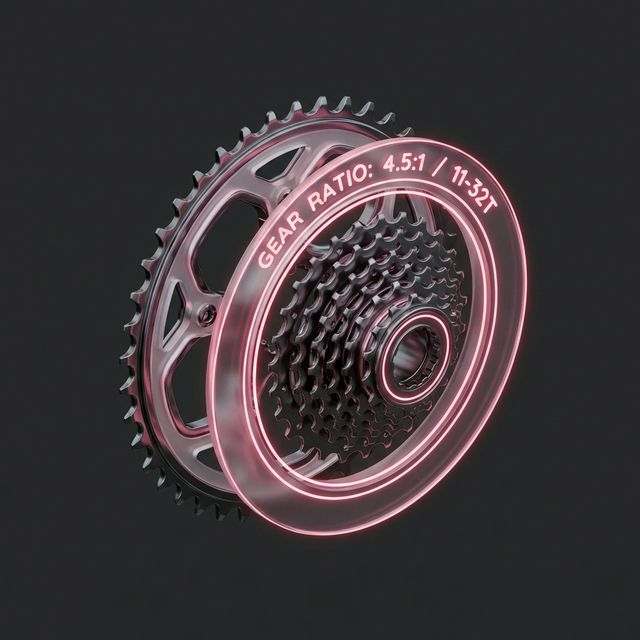
Bike Gear Ratio Calculator
Optimize your drivetrain. Compare different chainring and cassette combinations to find the perfect gear ratio for climbing or sprinting.
Drivetrain
Physics
Scientific Methodology & Accuracy
Our tools are built using peer-reviewed research and industry-standard formulas. This specific calculator utilizes GEAR RATIO CALCULATOR metrics validated by sports science organizations like the ACSM and NSCA.
The IOC consensus statements provide the most broadly accepted guidelines for nutrition and supplement use.
Performance Concept
"WinSportsLab provides the analytical framework necessary for high-stakes athletic competition."
Expert Protocol
"Learn to distinguish between 'good' muscle soreness and 'bad' structural pain to avoid injury. Extreme dieting while high-volume training often leads to hormonal imbalance and burnout."
Embed This Tool
<iframe src="https://winsportsus.com/tools/cycling/bike-gear-ratio-calculator" width="100%" height="800" frameborder="0" style="border-radius: 12px; box-shadow: 0 4px 6px rgba(0,0,0,0.1);"></iframe>
<div style="font-size: 12px; color: #888; margin-top: 8px; text-align: center;">Powered by <a href="https://winsportsus.com/tools/cycling/bike-gear-ratio-calculator" target="_blank" style="color: #D4705A; text-decoration: none;">WinSportsLab</a> </div>
Want to add this calculator to your own website? Simply copy the code above and paste it into your HTML. It's free!
How to Use This Tool
- 1
Enter your chainring size (front), cassette sprocket size (rear), and current cadence into the Bike Gear Ratio Calculator.
- 2
Review the calculated speed to confirm your gear selection matches your target training or racing velocity.
- 3
Use the gear ratio data to select optimal combinations: lower ratios for climbs, higher ratios for flat or downhill.
- 4
Compare multiple gear combinations to plan cassette and chainring selection before purchasing new drivetrain components.
Key Terminology
Frequently Asked Questions
Q1 How do I calculate my FTP from a 20-minute test?
Perform a 20-minute all-out time trial after a proper warm-up. Multiply your average power by 0.95 to estimate your 60-minute FTP. The 5% deduction accounts for the difference between 20-minute and 60-minute maximum efforts.
Q2 What W/kg ratio do I need to be competitive?
Category 4 racers average 2.5–3.0 W/kg FTP. Category 1–2 racers maintain 4.0–5.0 W/kg. Professional cyclists are at 5.5–6.5 W/kg. For group ride leaders, aim for 3.0+ W/kg.
Q3 How does cadence affect cycling performance?
Higher cadence (85–100 RPM) shifts effort from muscles to the cardiovascular system, reducing local muscular fatigue on long rides. Lower cadence (<70 RPM) increases torque demands and knee joint stress. Most coached cyclists aim for 85–95 RPM.
Q4 How do I calculate speed from gear ratio and cadence?
Speed (km/h) = (chainring teeth ÷ cassette teeth) × wheel circumference (m) × cadence (RPM) × 0.06. A 50×17 gear at 90 RPM with a 2.1m wheel circumference produces approximately 33.5 km/h.
How Bike Gearing Works: The Fundamentals
Every time your pedals make one complete rotation, the rear wheel turns by an amount determined by your gear ratio — the number of teeth on the front chainring divided by the teeth on the rear cog. A 50-tooth chainring with a 25-tooth rear cog produces a gear ratio of 2.0: two full rear wheel rotations for every pedal stroke.
The three key metrics this calculator provides:
- Gear Ratio (chainring ÷ cog): Pure mechanical comparison, independent of wheel size. Higher = harder.
- Gear Inches (gear ratio × wheel diameter in inches): A normalized unit developed in the early cycling era to compare gears across different wheel sizes. A 53×11 road bike combination at 700c = approximately 130 gear inches. A 28×32 MTB climbing gear = approximately 23 gear inches.
- Speed at Cadence (km/h or mph at a given RPM): Directly calculated from gear ratio, wheel circumference, and pedaling cadence.
Gear Ratio Reference by Terrain
| Terrain | Gear Ratio Range | Gear Inches | Typical Setup |
|---|---|---|---|
| Steep climbing (>10%) | 0.7 – 1.2 | 17–30" | MTB: 28T × 32–42T |
| General climbing | 1.2 – 2.0 | 30–50" | Road: 36T × 28T |
| Flats / moderate rolling | 2.0 – 3.0 | 50–80" | Road: 50T × 17–25T |
| Flats (high speed) | 3.0 – 4.0 | 75–100" | Road: 50T × 13–17T |
| Sprinting / TT | 4.0 – 5.5+ | 100–130"+ | Road: 53T × 11–13T |
Speed at Cadence Reference (700c Wheel, 25mm Tire)
| Gear Inches | 70 RPM | 80 RPM | 90 RPM | 100 RPM |
|---|---|---|---|---|
| 50" | 26 km/h | 30 km/h | 34 km/h | 37 km/h |
| 75" | 40 km/h | 45 km/h | 51 km/h | 56 km/h |
| 100" | 53 km/h | 60 km/h | 68 km/h | 75 km/h |
| 125" | 66 km/h | 75 km/h | 85 km/h | 94 km/h |
*Actual speed varies with tire width, inflation pressure, and rider position.*
Optimal Cadence: The Science Behind RPM
The optimal cycling cadence is a contested topic in sports science. Research supports the following:
- Recreational cyclists: Self-selected cadence of 60–80 RPM is common and energetically acceptable
- Trained cyclists: 80–95 RPM minimizes muscular fatigue and joint loading at sustained power outputs
- Sprinting: 110–130+ RPM during sprint efforts (the nervous system limits how fast muscles can contract efficiently)
A landmark study (Lucia et al., 2001, *Medicine & Science in Sports & Exercise*) found Tour de France cyclists averaged 89 RPM during mountain stages — significantly higher than recreational cyclists, suggesting that high cadence is a trained adaptation, not just a personal preference.
How to Use Gear Ratios for Drivetrain Optimization
Choosing a cassette for climbing: If you struggle on 8–10% grades, calculate whether your current lowest gear (easiest = smallest cog front, largest cog rear) falls below a 1.2 ratio. If not, consider an 11-32T or 11-34T cassette, which may require a longer-cage rear derailleur.
Checking for gear overlap: Most road groupsets have 20–22 gear steps, but the most extreme combos (big front + big rear, or small front + small rear) create drivetrain cross-chaining. Avoid using these combinations as they accelerate chain and chainring wear.
Gravel and bikepacking: Aim for a minimum low gear of 1:1 or lower for loaded touring on rough terrain. A 40T chainring with 42T cog (0.95 ratio) is considered a "bailout gear" by most gravel cyclists.
Use Cases / Example Scenarios
After a 20-minute all-out effort, use this tool to calculate your FTP and automatically set all 7 Coggan training zones.
Input your power output, body weight, and gradient to project your VAM (meters/hour) and compare to segment benchmarks.
Identify the optimal chainring/cassette combination for your target cadence (85–95 RPM) on your most common terrain.
Calculate sustainable race watts to prevent early fatigue. Stay at 88–93% FTP (Sweet Spot) for events over 90 minutes.
Related Guides
Related Tools
View All Tools →
FTP Calculator (Functional Threshold Power)
Calculate your Functional Threshold Power (FTP) from a 20-minute test and set your cycling training zones.

Sub-3 Hour Marathon Pace Calculator
The definitive guide and calculator for elite runners aiming to break the 3-hour marathon barrier.

Sub-3:30 Marathon Pace Calculator
Plan your strategy to break 3 hours and 30 minutes. The benchmark for advanced recreational runners.

Sub-4 Hour Marathon Pace Calculator
The most popular marathon goal. Calculate your splits to break the 4-hour barrier safely.